Matthews still gets to his spots. The puck stopped going in
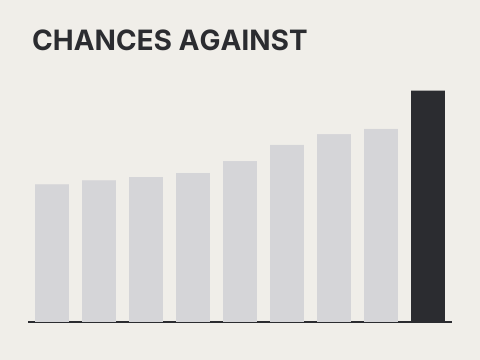
At five-on-five last season, nearly half his attempts came from within 20 feet, his highest share in five seasons, yet his finishing, across all situations, sat in the bottom tenth of regular forwards for the second year running.
Auston Matthews scored 69 goals in 2023–24, then 33 in 67 games and 27 in 60 (NHL.com). Missed games explain part of that drop. They don't explain what happened when he played.
Start with health. Daily Faceoff reported that an MCL injury ended his season, after earlier injury concerns. Toronto GM John Chayka now says he's "full go, 100%" for 2026–27, and Matthews told Ryan Leslie he's feeling particularly good (Daily Faceoff). How much his body had to do with the last two years is an open question.
What we can see is this. At five-on-five, Matthews still gets close to the net and still gets good looks. For two seasons, the puck hasn't gone in. On the power play, his shots also drifted away from the net last season. And his lift to Toronto's five-on-five offence has faded.

He still gets there
Matthews shoots less than he did from 2021–22 through 2023–24. Across all strengths, he's gone from about 525 unblocked attempts per 82 games over those three seasons to about 450 over the past two. Those counts include misses, but not blocked shots. Even so, only three regular forwards took more unblocked attempts per game last season.
The five-on-five shots he does take are as good as ever. Their average danger, the expected goals per attempt, was last season near his five-season high. He takes fewer shots from the slot than he used to, but about as many from within 20 feet of the net: about 140 five-on-five attempts per 82 games over the past two seasons, against about 147 over 2021–24. Last season's rate matched his 69-goal year.
The puck stopped going in
At five-on-five, he scored on 10.0% of his unblocked attempts over the three seasons from 2021–22. In 2024–25 that fell to 6.1%, and last season it was 7.4%.
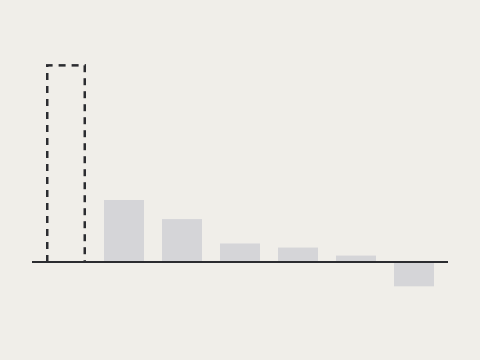
Across all strengths, his finishing grade, which measures scoring against what his chances were worth, tells the same story. Over 2021–24 it was in the top 5% of regular forwards. In each of the past two seasons it sat in the bottom tenth. That's worse than even his ordinary 2022–23, when he scored about what his shots were worth. Two straight years in the bottom tenth is more than a few posts.
On the power play, the shots moved out
On the power play he lost his finishing edge too. Over 2021–24 he beat his expected goals there by nearly four goals per 82 games. Over the past two seasons he's roughly matched them. Last season, the shots themselves got worse as well.

In 2024–25 his power-play looks bunched at the front of the net, and several of them went in. Last season the net front on his map is nearly empty. Most of his attempts came from the circles and above, each was worth about a third less, and he took fewer of them per game. The samples are small, 86 attempts and then 58, but the empty net front is hard to miss.
Is that Matthews not getting himself to the net, or the power play not getting him there? The change came in Toronto's first season after Mitch Marner was traded to Vegas in July 2025.
His lift to Toronto's offence faded too
The quieter decline is in what he does for everyone else. We estimate his effect on the chances Toronto generates at five-on-five: how much more dangerous the Leafs' chances are because he's on the ice. Over 2021–24 he was in the top 5% of regular forwards. In 2024–25 he was in the top 20%, and last season the top 30%.
One NHL executive, speaking anonymously to The Athletic's September player tiers panel, saw a slight dip in his game and said "not having Marner certainly hurt him." The slide, and its steepest part, came before the trade: Matthews was already down to the top 20% in 2024–25, with Marner still in Toronto, though last season's further drop and the power-play change came after he left.
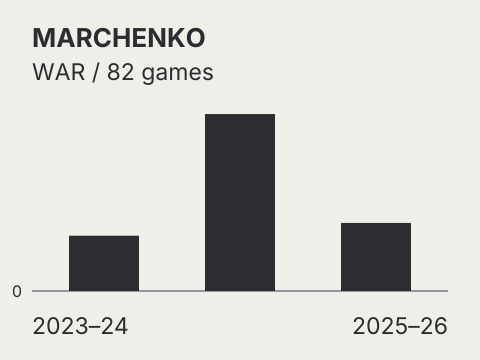
Put both declines on one scale. His WAR per 82 games fell from about four over 2021–24 to about one over the past two seasons combined. Finishing is the largest piece of that drop, and his effect on Toronto's five-on-five chances is the next.
Still very good, just not the Hart winner
Last season alone was better, at about 1.4 WAR per 82 games. That put him ahead of nearly nine in 10 regular forwards, and his defence improved. The same executive still called him elite, on a panel that placed him in Tier 2A. A coach on the panel thought even that was generous, based on last season. The panel's writers noted he was once regarded as one of the top three players in the game.
That's a very good player. It isn't the one who won the 2022 Hart Trophy and Ted Lindsay Award and was in the top 5% of regular forwards over 2021–24 in WAR per game, in finishing and in his effect on Toronto's five-on-five chances. Goals are the biggest part of the gap.
What to watch this season
If he keeps getting in tight at five-on-five and the puck starts going in at something like his old rate, the past two years were a dip, perhaps an injured one. If he keeps getting there and keeps missing, this is the finisher he is now.
On the power play, watch where he sets up, and where his teammates do. If the whole unit has drifted away from the net, that's the power play. If only Matthews has, it's him, or the spot he's been given.
Until then, Toronto has a centre who still finds dangerous ice at five-on-five and hasn't buried enough of it for two seasons.
Go deeper
Players and teams
Keep reading